
Editor's PickLife Guide
What to do if a car accident occurs? How to handle traffic accidents in Taiwan
G
Gina14d ago
When riding a motorcycle, driving a car, taking a bus, or even just walking in Taiwan, traffic accidents can happen. In the heat of the moment, many people get nervous and don't know whether to move the vehicles, take photos, or discuss compensation with the other party.
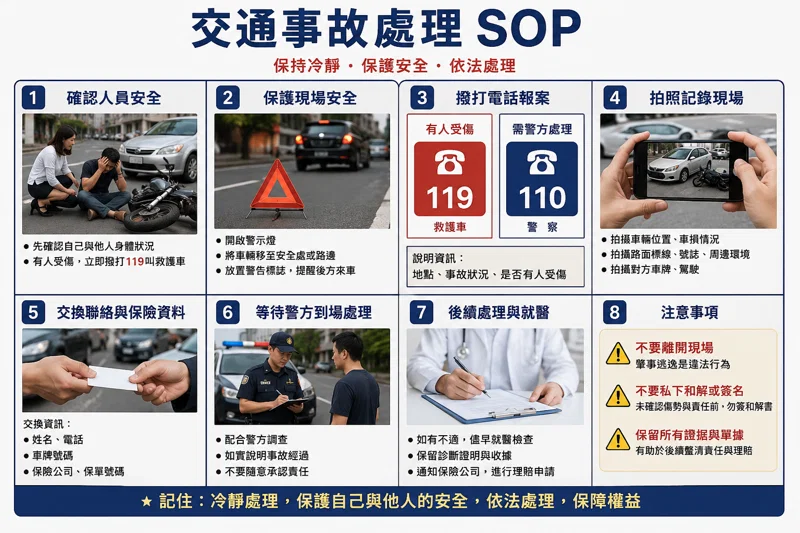
Regardless of whether the accident seems big or small, the first thing to do is not to argue about who is right or wrong, but to check if anyone is injured.
If someone is injured, unconscious, bleeding, experiencing chest pain, dizziness, or if vehicles are blocking the road and causing danger, call 119 for an ambulance immediately. If police presence is required, call 110. If there's a language barrier, first state the location, type of accident, and whether anyone is injured. Providing your location or mentioning nearby landmarks is more important than trying to form complete sentences.
If the accident occurs on a road with fast-moving traffic, do not stand in the middle of the lane arguing. First, ensure you and others can move to a safe location, turn on hazard lights, or warn oncoming traffic. Motorcycle riders who are able to move should also get out of the way of potential rear-end collisions.
If someone is injured, do not arbitrarily move the vehicles or the scene's evidence, unless it is to save a life or prevent greater danger. The law stipulates that when a traffic accident causes injury or death, the driver must provide first aid and notify the police. Vehicles and evidence must not be moved arbitrarily. If it's only vehicle damage with no injuries and the vehicles can still be driven, mark or photograph the positions first, then move the vehicles to the roadside as soon as possible to avoid obstructing traffic. Article 62 of the Road Traffic Management and Penalty Act also clearly states that failure to properly handle a no-injury accident, or failing to mark and move vehicles that can be driven promptly, thereby obstructing traffic, may result in a penalty.
Taking photos at the scene is important. You can start with a wide shot to show where the accident occurred (intersection, lane), then take close-ups including license plates, damage locations, skid marks, fallen positions, debris, traffic signals, road markings, intersection directions, and surrounding surveillance cameras. If you have a dashcam, ensure the footage is saved and not overwritten by new recordings.
When exchanging information with the other party, note down their name, phone number, license plate, insurance company, and owner's details. Do not hand over original passports, residence permits, driver's licenses, or health insurance cards to the other party for safekeeping, nor allow them to photograph excessive personal information. Once the police arrive, cooperate by explaining the accident details. Do not guess about uncertain matters, nor casually admit full responsibility due to language stress.
At the scene of an accident, some people may wish to "settle privately," especially for minor collisions. This is understandable, but do not accept money or sign documents too quickly. Sometimes, injuries are not felt immediately and only become apparent hours or even a day later. Vehicle repair costs may also be higher than initially assessed. If injuries, vehicle damage, and insurance have not been confirmed, it is best not to sign documents you don't understand, such as "fully settled" or "waiving future claims."
After reporting the accident, the police will usually provide traffic accident-related information or inform you of the subsequent application procedures. If you need to claim from your insurance company later, you will often need the accident registration details, medical diagnosis certificate, medical receipts, vehicle damage photos, repair estimates, and police report. If you are the driver, notify your insurance company as soon as possible; some insurance policies have requirements regarding reporting times and claim documents.
If you are a foreigner, do not immediately worry about your residency status due to a traffic accident. A general traffic accident itself does not equate to deportation. However, if it involves drunk driving, driving without a license, hit-and-run, serious injury or death, or criminal liability, the situation becomes much more complicated. The most important thing is not to flee the scene. A hit-and-run, especially when someone is injured or killed, has far more severe consequences than staying to handle the situation.
If you do not speak Chinese, you can ask a friend to help translate, or inform the police upon their arrival that you need language assistance. If you are truly unsure how to proceed, you can call the 1990 hotline for foreign residents in Taiwan to inquire about the relevant units to contact. If a migrant worker has an accident while commuting for work, you can also call 1955 to inquire about work-related injuries or employer responsibilities.
When a traffic accident occurs, remember the order: first, rescue the injured and ensure safety, then report to the police, take photos, exchange information, and finally discuss compensation and repairs. Do not leave the scene out of fear of trouble, nor sign settlement documents you don't understand because the other party is rushing you.
The calmer you are and the more information you preserve at the scene of the accident, the less likely it is that you will be left with conflicting accounts when dealing with insurance, medical, and liability issues later on.
How does this article make you feel?
1 people reacted