
Life Guide
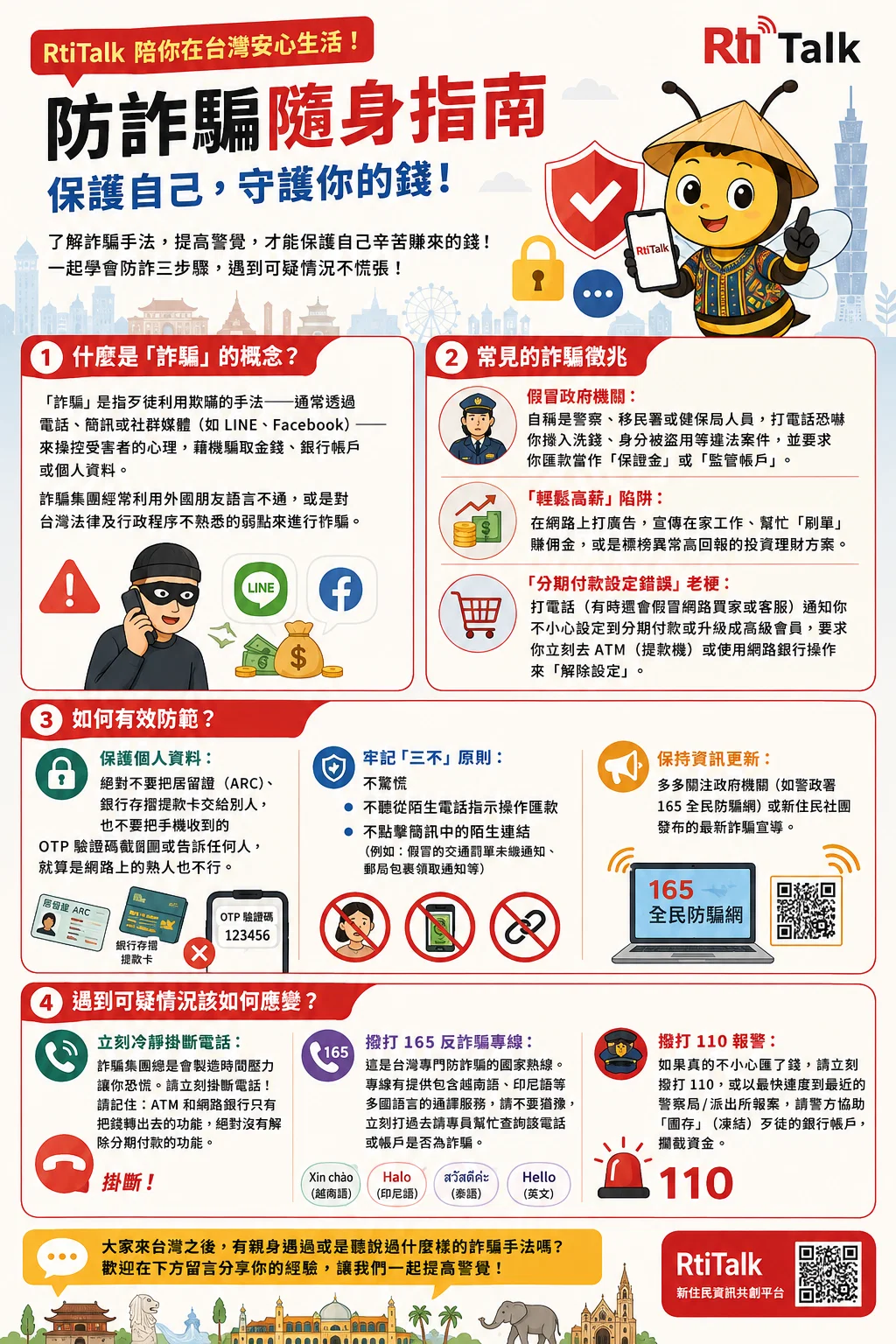
What is the concept of 'scam'?


在台的順1d agoEdited
A "scam" refers to criminals using deceptive methods—usually via phone, text messages, or social media (like LINE, Facebook)—to manipulate victims' psychology and trick them out of money, bank accounts, or personal information. Scam groups often exploit the weaknesses of foreign friends who are not proficient in the language or unfamiliar with Taiwan's laws and administrative procedures to carry out their fraud.
Common Signs of Scams
Impersonating Government Agencies: Claiming to be police officers, immigration officials, or National Health Insurance administrators, calling to threaten you with involvement in illegal cases like money laundering or identity theft, and demanding you transfer money as a "deposit" or for a "supervisory account."
"Easy High-Paying Job" Trap: Advertising online, promoting work-from-home opportunities, offering commissions for helping to "brush orders" (fake transactions), or promoting investment and financial management schemes with unusually high returns.
"Installment Payment Setting Error" Gimmick: Calling (sometimes impersonating online buyers or customer service) to inform you that you accidentally set up an installment payment or were upgraded to a premium membership, demanding you immediately go to an ATM or use online banking to "cancel the setting."
How to Effectively Prevent Scams?
Protect Personal Information: Absolutely never hand over your residence permit (ARC), bank passbook, or ATM card to anyone. Also, never screenshot or tell anyone the OTP verification code received on your phone, even if it's someone you know online.
Remember the "Three No's" Principle: No panic, no following instructions from unknown phone calls to transfer money, and no clicking on unfamiliar links in text messages (e.g., fake overdue traffic ticket notices, post office package pickup notifications, etc.).
Stay Updated: Pay close attention to the latest scam advisories issued by government agencies (like the National Police Agency's 165 Anti-Fraud Campaign website) or new immigrant communities.
What to Do When Encountering Suspicious Situations?
Hang Up Immediately and Calmly: Scam groups always create time pressure to make you panic. Please hang up the phone immediately! Remember: ATMs and online banking only have the function to transfer money out; they absolutely do not have the function to cancel installment payments.
Call the 165 Anti-Fraud Hotline: This is Taiwan's national hotline dedicated to fraud prevention. The hotline provides interpretation services in multiple languages, including Vietnamese and Indonesian. Please do not hesitate to call immediately and ask specialists to help check if the phone number or account is a scam.
Call 110 to Report to the Police: If you accidentally transferred money, please call 110 immediately, or go to the nearest police station as quickly as possible to file a report. Ask the police to assist in "freezing" the perpetrator's bank account to intercept the funds.
After coming to Taiwan, have you personally encountered or heard of any types of scams? Welcome to share your experiences in the comments below, so we can all raise our awareness together!
How does this article make you feel?
2 people reacted