
Editor's PickLife Guide
🌸 [Filial Piety is the First of All Virtues] The 7th Lunar Month Isn't Just About the Ghost Gate Opening! Unveiling the Origins of the 'Ullambana Festival of Filial Gratitude' and a Comparison of Festivals Across Asian Countries


在台的順7d agoEdited
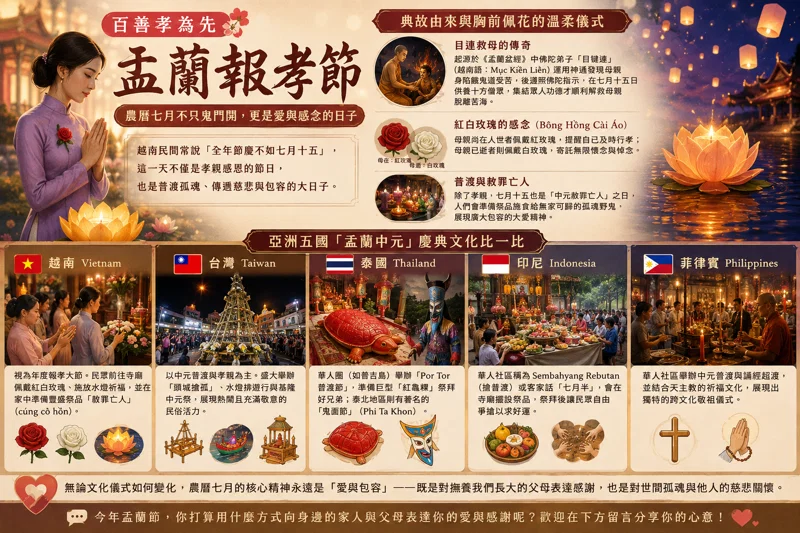
In Vietnam, it is often said that "no festival in the year compares to the 15th of the 7th lunar month." For many, the 7th lunar month is a mysterious "Ghost Month," but in Buddhism and East Asian culture, it is even more so the "Ullambana Festival of Filial Gratitude (Lễ Vu Lan)," filled with love and remembrance.
Origin of the Tale and the Gentle Ritual of Wearing Flowers on the Chest
The Legend of Mulian Saving His Mother: Originating from the "Ullambana Sutra," the Buddha's disciple "Mulian" (Vietnamese: Mục Kiền Liên) used his supernatural powers to discover his mother suffering in the realm of hungry ghosts. Later, following the Buddha's instructions, he made offerings to the monks of the ten directions on the 15th of the 7th lunar month. By gathering the merits of everyone, he successfully rescued his mother from the sea of suffering.
Remembrance with Red and White Roses (Bông Hồng Cài Áo): The most heartfelt cultural feature of Vietnam's Ullambana Festival is people going to temples to wear roses on their chests. Those whose mothers are still alive wear red roses, reminding themselves to practice filial piety in time. Those whose mothers have passed away wear white roses, expressing endless remembrance and mourning.
Pudu and Absolution for the Departed: Besides filial piety, the 15th of the 7th lunar month is also the day for "Zhongyuan Absolution for the Departed." People prepare offerings to feed wandering lonely ghosts, demonstrating a spirit of broad tolerance and great love.
A Comparison of "Ullambana and Zhongyuan" Festival Cultures in Five Asian Countries:
🇹🇼 Taiwan Focuses on Zhongyuan Pudu and filial piety. Grand events like "Toucheng Ghost King" (Qiang Gu), lantern parades, and Keelung Zhongyuan Festival showcase vibrant and respectful folk traditions.
🇻🇳 Vietnam Considered the annual grand festival of filial gratitude. People go to temples to wear red and white roses, release water lanterns for blessings, and prepare abundant offerings at home for "absolution for the departed" (cúng cô hồn).
🇹🇭 Thailand Chinese communities (e.g., Phuket) hold the "Por Tor Festival" (Pudu Festival), preparing giant "red turtle cakes" to worship hungry ghosts. In Northern Thailand, there is the famous "Phi Ta Khon" (Ghost Mask Festival).
🇮🇩 Indonesia Chinese communities call it Sembahyang Rebutan (Pudu Grab) or in Hakka, "Qiyueban." Offerings are set up in temples, and after the worship, people freely grab them for good luck.
🇵🇭 Philippines Chinese communities hold Zhongyuan Pudu and chanting for deliverance, combining it with Catholic blessings, showcasing unique cross-cultural ancestral veneration rituals.
Regardless of how cultural rituals change, the core spirit of the 7th lunar month is always "love and tolerance"—both expressing gratitude to the parents who raised us and showing compassion to lonely souls and others in the world.
This year's Ullambana Festival, how do you plan to express your love and gratitude to your family and parents? Feel free to share your thoughts in the comments below! 👇
How does this article make you feel?
2 people reacted